
The Sandwich Generation’s Guide to Survival

Many adults today care for aging parents while also supporting children, teenagers, or young adults, placing them in what’s commonly known as the sandwich generation. Being in the middle of that sandwich can bring pressure. For some families, the stress is mostly financial; for others, it’s emotional, logistical, or time-related. Often, it’s all of these at once.
You may be helping a parent manage medical appointments while paying for your child’s activities or assisting an adult child with rent while trying to save for your own retirement. Even families with stable incomes can feel stretched when multiple generations need support at the same time.
What makes this stage especially difficult is that many of these responsibilities happen at once. Parents may need more support just as college bills rise, careers become more demanding, or retirement starts to feel closer.
Although there are no easy solutions, a few practical steps can help you feel more in control.
Do an Initial Assessment
One reason the sandwich generation feels so overwhelming is that costs and responsibilities tend to build slowly over time. Taken individually, they don’t seem alarming: a grocery run here, a prescription there, extra driving, help with tuition, covering a phone bill, paying for summer camp, or ordering takeout because there was no time to cook. Together, they can quietly reshape your budget.
That’s why one of the most helpful first steps is getting organized. Spend a month tracking every expense connected to supporting family members, even the smaller ones. Include things like gas for extra driving, pharmacy trips, household help, streaming subscriptions, or money sent through payment apps.
At the same time, pay attention to time costs. Are you regularly missing work hours, using vacation days for caregiving, or spending evenings managing someone else’s paperwork or appointments? Those demands affect your financial life, too, even if they don’t appear on a credit card statement.
You may be surprised by what you discover once everything is written down. The goal isn’t to eliminate support; it’s to understand what is sustainable and where adjustments may be needed.
Once you’ve identified where your money and time are going, look for areas where support has become automatic rather than intentional. Are you covering a bill no one has discussed in months, paying for something your adult child could now handle, or taking on caregiving tasks that could be shared? Some commitments may still make sense, but others may need new boundaries, clearer expectations, or a defined end date.
Prioritize Effectively
When both parents and children need help, it can feel like every request deserves immediate attention. Parents want to help their children succeed, and adult children want to keep aging parents safe and comfortable. The challenge is that not every need can be addressed at once, and consistently offering financial support can create stress for you and the family members relying on you.
That’s why, in many situations, structure helps even more than unlimited support. For adult children, that might mean setting expectations around how long financial help will continue or agreeing on specific goals tied to that funding. Instead of covering every expense indefinitely, you might help with rent for six months while they build savings or search for full-time work.
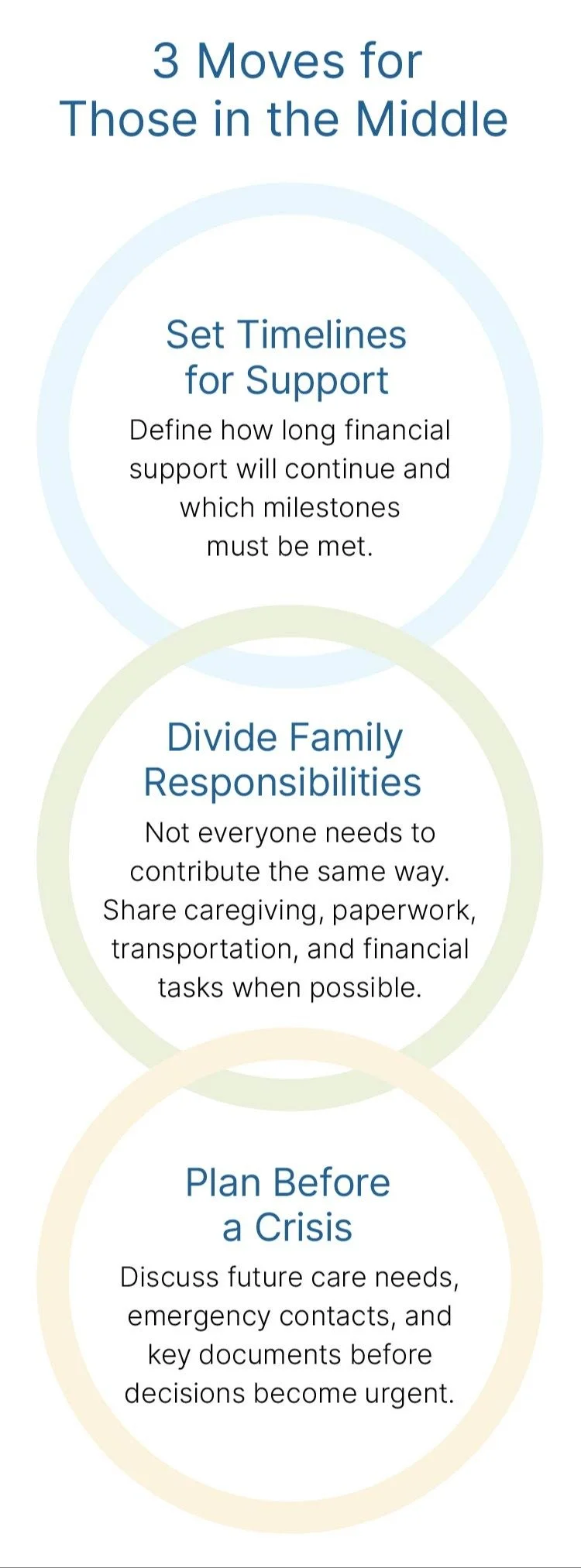
With aging parents, the conversations may be different but are equally important. If possible, involve parents in these discussions while they can still make and communicate their own decisions. Many families avoid discussing finances, health issues, housing plans, or future care because those conversations feel uncomfortable. Unfortunately, waiting until there is a medical emergency often limits choices and increases stress for everyone.
Even discussing simple questions like these can help families prepare:
What kind of help might be needed over the next few years?
Are important documents (e.g., wills, powers of attorney, health care directives, and account information) organized and accessible?
Who would step in during an emergency?
Are responsibilities being shared fairly among family members?
You don’t need every answer immediately. Starting the conversation itself is often the hardest part. The sooner these discussions begin, the more options families tend to have.
Look Out for Yourself
One of the biggest mistakes people in the sandwich generation make is treating their own financial needs as permanently optional. It may feel easier to pause retirement savings, ignore growing debt, or repeatedly dip into emergency funds while helping family members. After all, your parents or children may need help right now. But your future matters, too.
Retirement savings, emergency reserves, and insurance coverage are not selfish priorities. They help prevent financial stress from continuing into the next stage of life. Before committing additional support to family members, be sure that your essential bills are covered, your insurance coverage is adequate, and your core savings goals remain on track. Without a plan, you risk becoming financially dependent on others later on, even after spending years helping everyone else.
If finances feel tight, focus on maintaining progress rather than perfection. Continuing to save something for retirement, even at a lower amount temporarily, is better than stopping completely. The same goes for paying down high-interest debt or rebuilding emergency savings gradually over time. Small, consistent steps tend to be more sustainable than drastic financial swings.
Consider the Emotional Toll
The sandwich generation is often discussed in terms of money, but the emotional and physical responsibilities can be just as significant. If relatives or trusted friends can help, be specific about what would actually lighten the load. One person may be willing to handle medical paperwork. Another may help with transportation or meal preparation. The same principle can apply to siblings. One person may contribute financially, another may coordinate appointments, and another may handle paperwork.
If family members are helping manage finances or medical decisions, make sure the appropriate legal documents are in place and clearly identify who has authority to act on behalf of a parent. Equal responsibility does not always mean identical responsibility.
Workplace flexibility, caregiver support groups, community services, local senior resources, and employer benefits may also help reduce pressure. Some employers offer caregiver resources, flexible schedules, employee assistance programs, or family leave options. Many families wait until burnout before exploring those options. Factoring in your own stress, time, and energy can help you make more realistic decisions about what you can take on.
A Financial Advisor Can Help
For members of the sandwich generation, financial planning is rarely about one goal at a time. It’s about balancing several important priorities that often compete with one another. A financial advisor can help organize those competing demands into a clearer plan. That may include reviewing cash flow, prioritizing goals, evaluating retirement readiness, discussing future care expenses, or helping families think through difficult trade-offs more objectively.
Sometimes, the biggest benefit is simply having someone help you sort through decisions that feel emotional and overwhelming. There may never be a perfect balance when multiple generations depend on you at once. But clearer boundaries, earlier conversations, and a realistic plan can help reduce stress and build confidence about the future.
FAQs About The Sandwich Generation’s Guide to Survival
-
The sandwich generation refers to adults who are simultaneously supporting aging parents and children, teenagers, or adult children. This can create competing financial, caregiving, and time demands, making it important to balance family support with personal financial goals such as retirement savings and emergency reserves.
-
A helpful first step is to assess where money and time are going. Tracking family-related expenses for a month can reveal recurring costs that may have become automatic. From there, families can establish priorities, set reasonable boundaries around financial support, and create a plan that accounts for both current responsibilities and long-term goals.
-
Before providing additional financial support to aging parents, review your own essential expenses, emergency savings, insurance coverage, debt, and retirement contributions. Maintaining progress toward retirement—even if contributions temporarily need to be reduced—can help prevent today's support from creating financial dependence later in life.
-
Supporting an adult child may be appropriate, but it is important to establish clear expectations and limits. Families might consider defining how long financial assistance will continue or tying support to specific goals, such as finding employment or building savings. A financial plan can help determine how much assistance is sustainable without sacrificing essential retirement goals.
-
Families should consider discussing future care needs, housing preferences, financial resources, wills, powers of attorney, health care directives, and who would make decisions in an emergency. Having these conversations before a crisis occurs can give families more choices and make it easier to coordinate responsibilities.
-
A financial advisor can help members of the sandwich generation evaluate competing priorities and develop a coordinated financial plan. This may include reviewing cash flow, retirement readiness, emergency savings, insurance, potential future care expenses, and the financial support being provided to children or parents.
-
Families in Glastonbury and throughout Connecticut may benefit from working with a financial advisor who can help integrate caregiving responsibilities with broader financial goals. A personalized plan can help families evaluate retirement savings, family support, future care costs, and other competing priorities while establishing sustainable boundaries around financial assistance.
The content is developed from sources believed to be providing accurate information. The information in this material is not intended as tax or legal advice. It may not be used for the purpose of avoiding any federal tax penalties. Please consult legal or tax professionals for specific information regarding your individual situation. This material was developed and produced by FMG Suite to provide information on a topic that may be of interest. FMG, LLC, is not affiliated with the named broker-dealer, state- or SEC-registered investment advisory firm. The opinions expressed and material provided are for general information, and should not be considered a solicitation for the purchase or sale of any security. Copyright 2026 FMG Suite.
© 2026 Commonwealth Financial Network®