

Financial scams aren’t new, but they’re becoming harder to recognize. A suspicious email filled with spelling mistakes may still show up in your inbox, but today’s scams can also look like legitimate bank alerts, convincing social media posts, or polished investment websites. A phone call may even sound like it’s coming from someone you know.
Technology has given scammers new ways to make their stories seem believable, but the basic tactics haven’t changed much. Fraud still relies on trust, emotion, and pressure to persuade people to act before they have time to think.
The good news is that you don’t have to keep up with every new scam to protect yourself. Learning to recognize a few common warning signs and knowing what to do when something doesn’t feel right can help you avoid being caught off guard.
The Rise of Scams
New technology makes it easier to create messages that look and sound authentic. Artificial intelligence, or AI, can produce realistic emails, images, videos, and even copies of a person’s voice. A scammer may be able to imitate a relative, friend, or colleague using audio found online.
Social media can also provide useful information to someone trying to fool you. Public posts may reveal where you work, where you travel, who your relatives are, or what companies and financial topics interest you. Those details can make an unexpected message or phone call feel more personal and believable.
Phone numbers, email addresses, and websites can also be disguised to look familiar. Something that looks or sounds legitimate isn’t necessarily so.
Instead of asking only, “Does this seem real?” ask a more useful question: “Can I confirm this another way?”
Red Flags
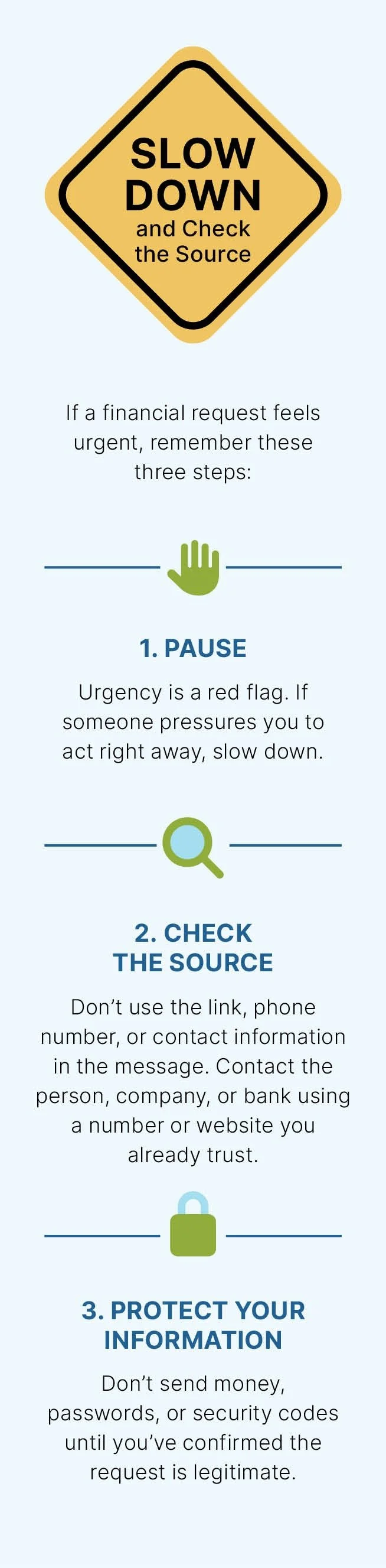
Many scams are designed to create a strong emotional reaction. The story may change, but the goal is often the same: get you to act quickly instead of stopping to question what’s happening.
Someone might claim there’s suspicious activity in your bank account, that you owe money, that a relative is in trouble, or that you’re about to miss a great opportunity.
Be cautious if someone:
Pressures you to act immediately or tells you not to discuss the situation with anyone else
Unexpectedly asks for a password, Social Security number, bank information, or a security code sent to your phone
Tells you to move money to another account to keep it “safe”
Asks you to pay using gift cards, cryptocurrency, a wire transfer, or another method that may be difficult to reverse
Promises unusually large or guaranteed investment returns with little or no risk
An unexpected request doesn’t automatically mean you’re dealing with fraud. But it does mean you should stop and verify the information before taking action.
Common Tactics
One of the most common approaches is impersonation or pretending to be someone you’re likely to trust. A scammer might pose as your bank, a government agency, a familiar company, a police officer, your employer, or someone you know personally.
For example, you might receive a call or text saying there’s fraud in your bank account. The person may know your name or other personal details and may even appear to be calling from your bank’s phone number. Then they tell you to move your money to another account for protection. In reality, the “safe” account belongs to the scammer.
Investment scams may begin with an advertisement, social media post, or unexpected message promoting an opportunity that supposedly offers unusually strong returns. Some scams use convincing websites or apps that appear to show your money growing even though no legitimate investment exists.
Other scams unfold more slowly. Someone you meet online may build a friendship or romantic relationship before asking for money or recommending an investment. A job offer may promise easy income but require an upfront fee or ask you to deposit a check and send some of the money elsewhere. Someone posing as a technology-support representative may claim there’s a problem with your computer or account and ask for access to your device.
People who have already experienced fraud can also be targeted again. Be wary of anyone who unexpectedly promises to recover lost money in exchange for an upfront payment or personal information.
The details vary, but the pattern is often similar: build trust, create urgency, and then ask you to act.
Helpful Habits
You don’t need to become a fraud expert. A few simple habits can make a meaningful difference:
Verify unexpected requests yourself. Don’t click a link in the message or call the number the person gives you. Instead, contact the person or organization using information you already trust. If the message supposedly came from your bank, for example, call the number on the back of your debit or credit card or go directly to the bank’s website.
Confirm urgent requests from people you know. If a friend or relative asks for money unexpectedly, contact that person another way using a phone number you already have, even if the caller sounds like them.
Protect your accounts. Use a different password for each important account and turn on two-step verification when it’s available. This means you need another form of proof in addition to your password, such as a code on your phone. Never give that code to someone who contacts you unexpectedly.
Have a family plan. Decide ahead of time how you’ll confirm emergency requests. Some families agree that no one will send money based only on an unexpected call or text. Others choose a private word or question to verify one another’s identity.
If you suspect fraud
If something doesn’t seem right, stop communicating with the person and don’t send any more money or information.
If you already made a payment, contact the bank, credit card company, or payment service involved as soon as possible. Explain that you believe the transaction was connected to a scam and ask whether it can be stopped, reversed, or challenged.
If you shared a password, change it immediately. If you used the same password for other accounts, change those too. Turn on two-step verification wherever possible.
If sensitive personal information, such as your Social Security number, may have been exposed, visit IdentityTheft.gov for steps based on what happened. You can also report suspected fraud to the Federal Trade Commission at ReportFraud.ftc.gov . You can report internet-related scams to the FBI through IC3.gov .
Review your bank and credit card statements for transactions you don’t recognize. Depending on what information was exposed, you may also want to consider a credit freeze. A credit freeze is free and helps prevent new credit accounts from being opened in your name until you remove it.
And if you’re not sure what to do, ask someone you trust. A family member, financial advisor, or other trusted person can provide a second perspective when you’re being pressured to make a quick financial decision.
FAQs About Financial Scams
-
Common financial scams include phishing emails, bank impersonation calls, investment fraud, romance scams, fake job offers, and technology-support scams. Scammers may also use artificial intelligence (AI) to create convincing emails, phone calls, images, and videos. Many scams rely on urgency, fear, or promises of unusually high investment returns to persuade people to act without verifying the information.
-
Be cautious of investment opportunities that promise guaranteed returns, unusually high profits, or little to no risk. Other warning signs include unsolicited investment offers, pressure to invest immediately, requests for cryptocurrency or wire transfers, and websites or apps that cannot be independently verified. Before investing, research the opportunity and the individuals or companies involved. If something sounds too good to be true, take time to investigate before committing your money.
-
Protecting your financial information starts with using unique, strong passwords for important accounts and enabling two-step verification whenever possible. Avoid sharing passwords, Social Security numbers, banking details, or security codes in response to unexpected requests. Be cautious about the personal information you share on social media, and always verify unexpected messages or phone calls by contacting the organization directly through a trusted phone number or website.
-
Do not transfer money based on an unexpected phone call, text, or email, even if the person appears to be calling from your bank's legitimate phone number. Scammers can disguise caller ID information and may use personal details to sound convincing. Instead, end the conversation and contact your bank using the phone number on the back of your debit or credit card. A legitimate financial institution should not require you to move money into an unfamiliar account to protect it.
-
If you suspect you've been scammed, stop communicating with the individual and do not send additional money or personal information. Contact your bank, credit card company, or payment provider immediately to report the transaction and ask whether it can be reversed or stopped. Change any compromised passwords, review your financial statements for suspicious activity, and consider placing a freeze on your credit if sensitive information was exposed. You can also report fraud through the Federal Trade Commission at ReportFraud.ftc.gov or the FBI's Internet Crime Complaint Center.
-
Older adults can be targeted by scammers who impersonate family members, financial institutions, government agencies, or trusted professionals. Families can help reduce the risk by discussing common scam tactics, establishing a plan to verify unexpected requests for money, and encouraging loved ones to consult someone they trust before making significant financial decisions. A financial advisor can also help families evaluate financial decisions and identify potential warning signs when something doesn't seem right.
-
A financial advisor can help you make informed financial decisions, evaluate investment opportunities, and consider how unexpected financial losses could affect your long-term goals. While a financial advisor cannot prevent every scam or guarantee protection against fraud, having a trusted professional to consult can provide an additional perspective when evaluating suspicious investment opportunities or unexpected requests involving your money. At Atlantic Wealth Advisors in Glastonbury, Connecticut, we believe informed financial decisions are an important part of building and maintaining long-term financial security.
The content is developed from sources believed to be providing accurate information. The information in this material is not intended as tax or legal advice. It may not be used for the purpose of avoiding any federal tax penalties. Please consult legal or tax professionals for specific information regarding your individual situation. This material was developed and produced by FMG Suite to provide information on a topic that may be of interest. FMG, LLC, is not affiliated with the named broker-dealer, state- or SEC-registered investment advisory firm. The opinions expressed and material provided are for general information, and should not be considered a solicitation for the purchase or sale of any security. Copyright 2026 FMG Suite.
© 2026 Commonwealth Financial Network®